

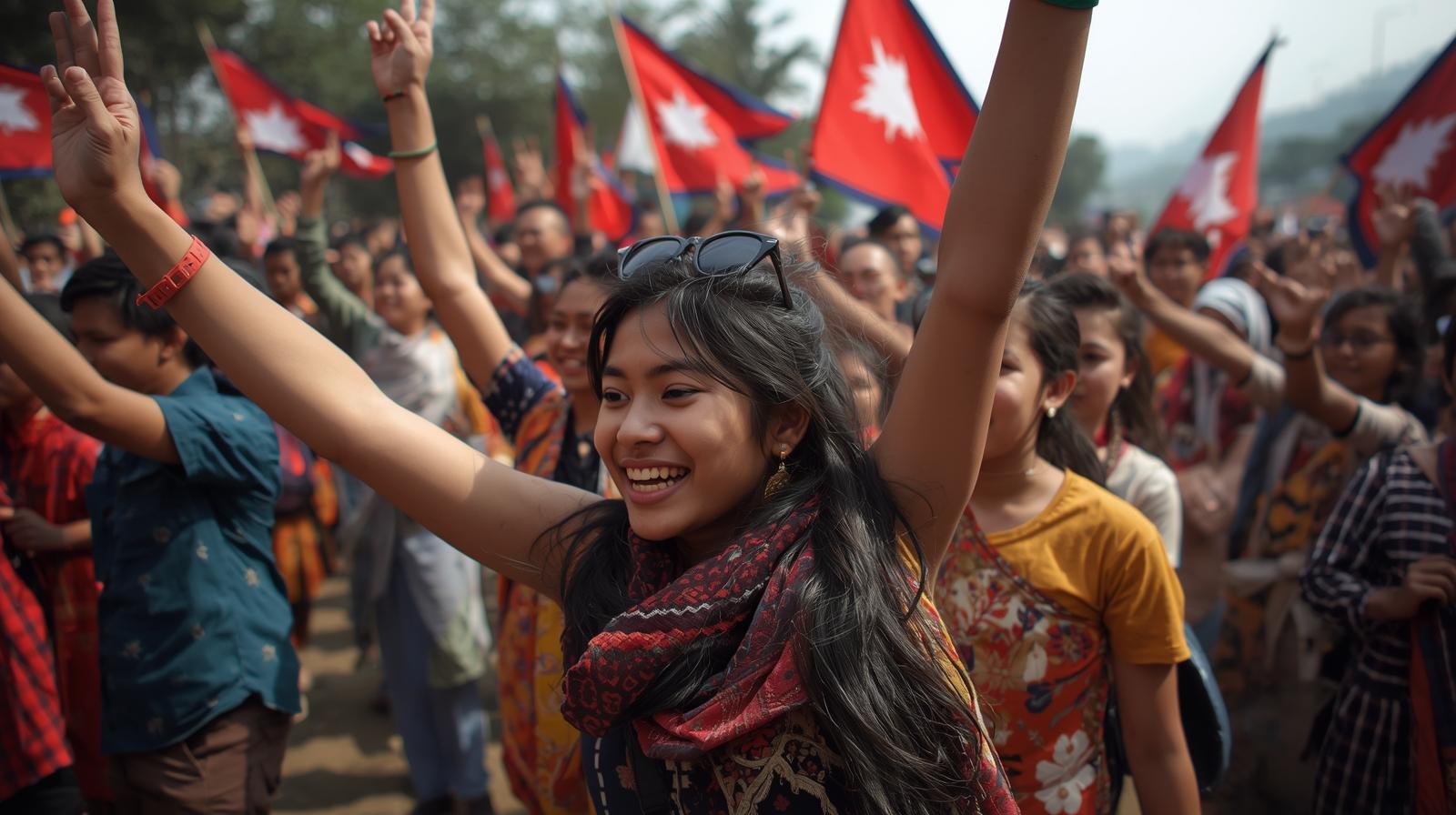
Nepal’s Gen-Z revolution- a Gen-Z cohort’s movement steam from the massive dissatisfaction among the youth in the country. For decades, Nepali politics was the games of old men in old rooms. Veteran leaders like Sher Bahadur Deuba (5times), KP Sharma Oli (4th times) and Puspa Kamal Dahal (3 times) became the Prime ministers of Nepal. However, they were unable to deliver the expected result, and were engaged in corruption. They and their family members had lavish lifestyle leaving general people destitute. For this reason, corruption simmered, and it spilled into the streets as Gen-Z protest.
This seismic shift was possible because Gen-Z is digitally-native, globally-conscious, and fiercely impatient. They used social platform to organize, and initiated the protest against government. The slow-burning frustration culminate to Gen Z movement started on 8th September 2025, and claim at least 72 people’s life, pressurized Prime Minister KP Sharma Oli to resign citing “the extraordinary situation”.
The Tinder: A Foundation of Frustration
Frustration of people spills into the street after the deep dissatisfaction of youth. Following are the highlights of those frustrations:
- Social Media Band: On August 25, 2025, the KP Oli government imposed a ban on 26 digital platforms—including Facebook, Instagram, WhatsApp, and YouTube. This action targeted platforms that had failed to comply with the registration requirements mandated by Nepal’s Directive on Regulating the Use of Social Media, 2023. This decision is particularly significant given that these patforms, especially Facebook and YouTube, are integral to daily life in Nepal for communication, entertainment, and income generation. Such a prohibition risked fostering widespread public discontent.
- Political Stagnation: Nepal has experienced a persistent cycle of coalition governments, primarily among the three major parties—the Nepali Congress, CPN-UML, and the Communist Party of Nepal (Maoist Centre). These administrations have been frequently implicated in rampant corruption scandals, with political parties appearing more focused on power-sharing than on substantial problem-solving. The same leadership, notably Sher Bahadur Deuba(serving his fifth terms), KP Sharma Oli (his fourth), Puspa Kamal Dahal (his third), has rotated through positions of authority. A consistent pattern has emerged wherein grand promises are made during election campaigns, followed by minimal delivery upon taking office.
- Economic Anxiety: Crippling unemployment and underemployment became the norm. Despite being the most educated generation in Nepal’s history, the youth faced a future with severely limited opportunities. This reality fueled a mass exodus for foreign employment, with approximately 1,800 to 2,200 individuals leaving the country daily for this purpose. According to the Department of Foreign Employment, a total of 759, 208 Nepalese migrants received approval for foreign employment in the fiscal year ending in mid-July 2024. For many, the dream of building a prosperous life in their own country felt increasingly out of reach.
- Social Disconnect: The established parties, rooted in outdated feudal and patriarchal structures, failed to represent their modern values. Gen Z’s concerns—climate change, LGBTQ+ rights, individual liberty, and digital freedom—were absent from the traditional political agenda.
How They Got Organized?
Ironically, despite the government’s prohibition, protesters effectively coordinated their activities using Virtual Private Networks (VPNs) and encrypted messaging applications. Prior to the platform’s restriction, hastags such as #UnbanSocialMedia gained significant traction on TikTok. Simultaneously, forums like Reddit provided the organizational infrastructure that enabled young activists to translate online outrage into tangible real-world action.
What happened in the Protest?
Nepal’s Day of Rage: From Protest to National Crisis
On September 8, 2025, a peaceful rally in New Baneshwor escalated into a violent uprising, marking a “day of rage.” The demonstration began peacefully in the morning but intensified by midday as predominantly Gen-Z protesters breached barricades and stormed the Parliament building. In an attempt to disperse the crowd, police employed extreme force, including water cannons, tear gas, and rubber bullets, later escalating to the use of live ammunition. Similar confrontations occurred nationwide, resulting in at least 19 fatalities and dozens of injuries on the first day alone.
As the situation spiraled out of control, authorities imposed a curfew across Kathmandu Valley, later extending it to other sensitive zones, including Bhaktapur and Lalitpur. In effect, a curfew blanketed nearly the entire country. Despite these measures, the protests persisted. That evening, under mounting pressure, the government of KP Sharma Oli lifted the social media ban, and Home Minister Ramesh Lekhak tendered his resignation.
The following day witnessed a significant escalation in violence. Protestors set fire to key government institutions, including Singha Durbar (the nation’s administrative headquarters), the adjacent Supreme Court, Sital Niwas (the President’s residence), and Baluwatar (the Prime Minister’s residence). With public fury reaching an apex, Nepal Army Commander General Ashok Raj Sigdel advised Prime Minister Oli to resign to enable the Army to restore order.
Furthermore, protesters vandalized the central offices of major political parties—including the Nepali Congress, CPN-UML, and the Communist Party of Nepal (Maoist Centre)—desecrating and burning their flags. In a bid to quell the unrest, Agriculture Minister Ram Nath Adhikari, Health Minister Pradip Paudel, and 21 Members of Parliament from the Rastriya Swatantra Party resigned. However, these concessions failed to placate the public anger.
The turmoil extended to Tribhuvan International Airport (TIA), where protesters gathered to prevent political leaders from fleeing the country. Consequently, the airport was closed and secured by the Nepali Army, leading to the diversion or cancellation of international flights. Private entities, such as the Kantipur Media Group and a Hilton Hotel, were also set on fire. In essence, hundreds of public and private infrastructures were severely damaged or destroyed.
Political leaders faced direct attacks. The residences of former Prime Minister Sher Bahadur Deuba and incumbent Foreign Minister Arzu Rana Deuba were set on fire, and both officials sustained injuries before being handed over to police for their safety. Deputy Prime Minister Prakash Man Singh’s home and vehicles were also burned. This pattern of attacks extended to the properties of former President Bidya Devi Bhandari, former Prime Ministers Jhala Nath Khanal and Pushpa Kamal Dahal, among many others, with similar scenes unfolding across Nepal.
At 10:00 PM Nepal Time, in the absence of effective civilian leadership, the Nepali Army assumed control of the country to maintain law and order. Army Chief General Sigdel appealed for dialogue with the protest leaders.
The next day, army patrols were deployed nationwide, and the military facilitated negotiations on behalf of the President. Consequently, former Chief Justice Sushila Karki was appointed to lead an interim government, charged with the primary mandate of conducting elections within six months.
Aftermath
At least 71 people were killed in the protests, with more than 2,100 injured. Protests destroyed numerous public offices, destroying equipment of essential services.